← Back to Work View Part II ↓
Service Design · Strategic Research

Token Trust

An ethical AI data governance platform converting user-contributed data into measurable, compensable value.

Team
Michael Joongmin Park Team Lead
Jaehong Hwang Research
Elsie Jang Research
Brian Machado Assistance
Jaydyn Congreves Assistance
View Service Component Detail ↓
Year
2026 / Mar
Type
Service Design, Strategic Research
Duration
6 Weeks
Status
Online · Published via GitHub
michaeljpark.github.io/tokentrust →
86%
Idea acceptance rate — ICE framework (Impact, Confidence, Ease) + feedback, internal
5 teammates · Alexander Manu / Mahnoor Hasan (Project Advisors)
81%
of survey respondents agreed with the AI pricing problem (score ≥4 out of 5, n=28)
Feb 21, 2026
+67%
YoY growth in global AI spending — $1.5T (2025) → $2.5T (2026)
Gartner, Jan 2026
84%
of business leaders say data sovereignty regulations grew more important in 2026
75%
of consumers won't purchase from organizations they don't trust with their data
$30B+
Total addressable AI token market in 2026

Data invisibility and
the birth of TokenTrust

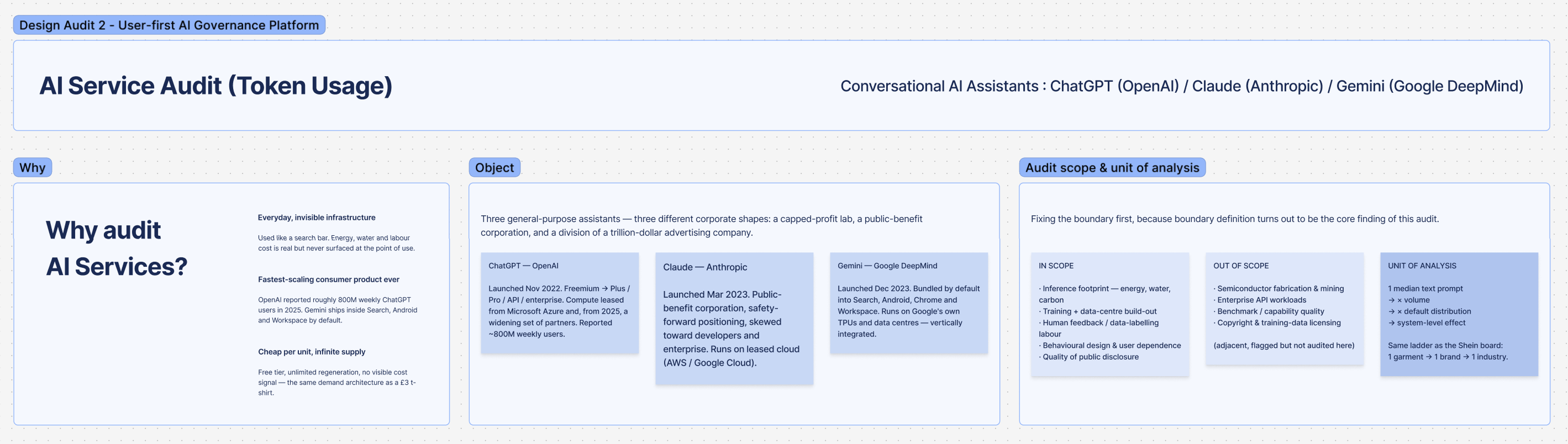
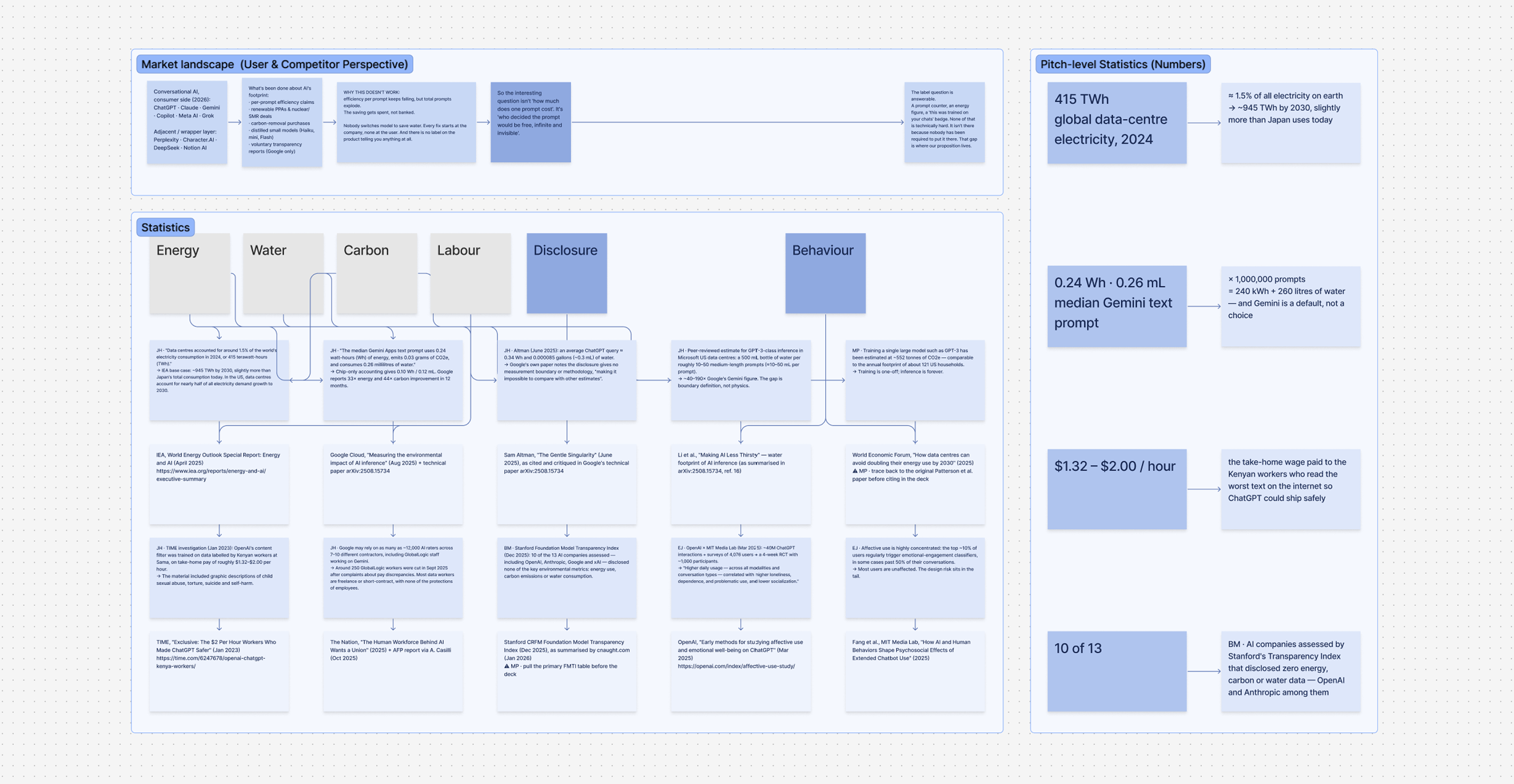
We use AI every day without a second thought. But three structural questions remain unanswered — and TokenTrust is built to answer them.

Question I
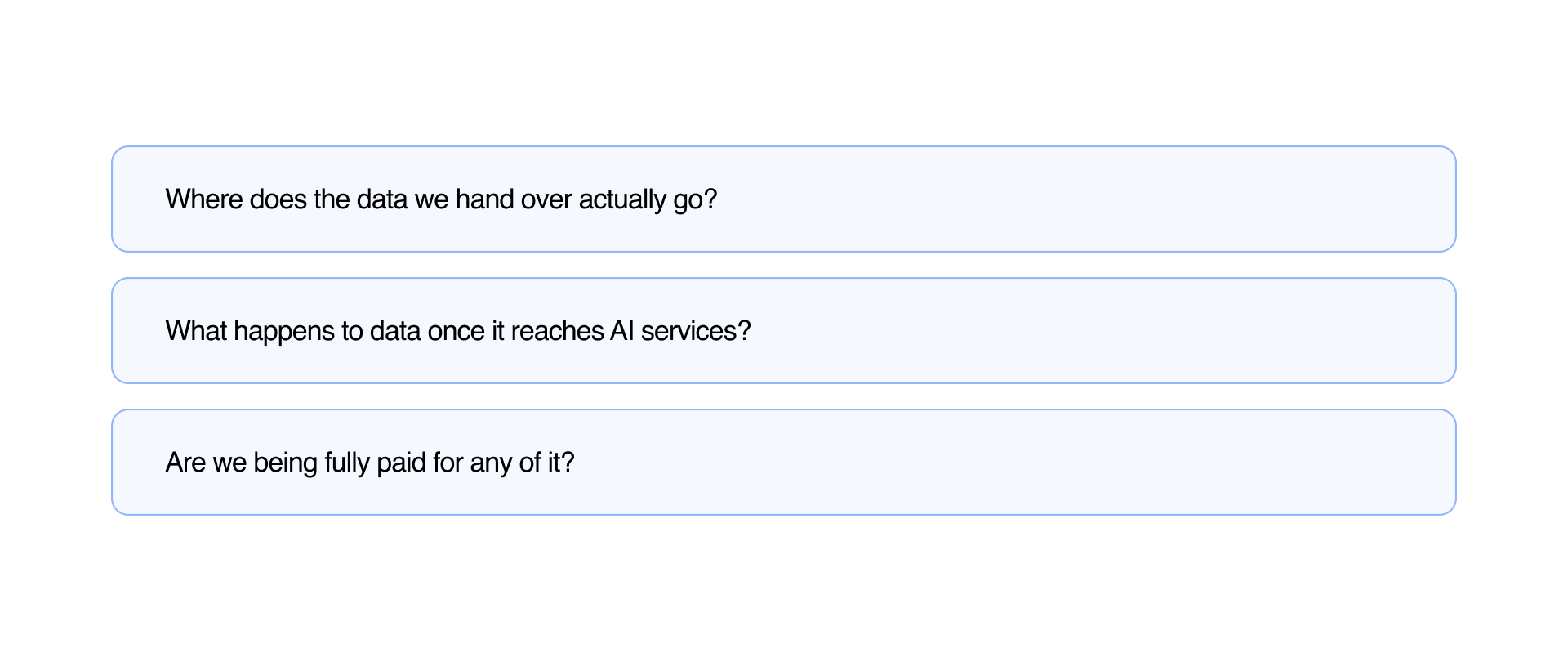
Where does the data we provide to AI actually go?

"We use AI every day without a second thought. But we have no visibility into how AI enterprises handle our data, or whose hands it ends up in."

Question II
How is the data we provide being processed?

"Is our data being processed? Stored? Or fed into the next AI model? We simply do not know. Just like the black box of AI thinking, what happens to our data remains invisible to us."

Question III
Are AI companies properly rewarding us for the value of our data?

"AI enterprises walk away with our intellectual property and the value of our data. And still, we are the ones writing the check. Where exactly did our data rights go?"

Built on GDPR's
three pillars

GDPR requires companies to obtain user consent and ensure transparency when collecting and using personal data. TokenTrust operationalizes its three core principles into a governance framework.

Privacy

Protects personal data and ensures secure handling across the entire data lifecycle — from collection to deletion.

"Data protection should be integrated into technology design from the beginning." — GDPR, Art. 25 & Recital 78

Consent

Requires clear user permission before data collection and use, with the right to withdraw at any time without consequence.

"The data subject shall have the right to withdraw his or her consent at any time." — GDPR, Art. 7

Control

Gives users the right to access, modify, and delete their data — placing the individual at the center of data governance.

"Controller means the natural or legal person which determines the purposes and means of the processing of personal data." — GDPR, Art. 4(7)

Data sovereignty is
no longer optional

The Global Sovereign Cloud Market was valued at $129 billion in 2025 and is projected to reach $572.3 billion by 2032 — growing at 24% CAGR, driven by mounting regulatory pressure and eroding user trust.

84%

of business leaders say data sovereignty and repatriation regulations have grown more important over the past year.

Kyndryl via PR Newswire, March 2026

75%

of consumers say they won't purchase from an organization they don't trust with their data.

Cisco 2024 Consumer Privacy Survey

24%

CAGR — Global Sovereign Cloud Market growing from $129B in 2025 to $572.3B by 2032.

MarkNtel Advisors via PR Newswire, March 2026

Global AI Market Spending Total worldwide AI spending ($B) · 2022–2026 · *2022–2024 estimated $0 $500B $1T $1.5T $2T $2.5T $200B 2022* $400B 2023* +100% $900B 2024* +125% $1.5T 2025 Gartner +67% $2.5T 2026 Gartner proj. +67% Sources: Gartner (Jan 2026) · CloudZero State of AI Costs 2025 · *2022–2024 market estimates
Global AI Market Spending Total worldwide AI spending · 2022–2026 $500B $1T $1.5T $2T $2.5T 2026 proj. $2.5T ↑ +67% 2025 Gartner $1.5T ↑ +67% 2024 est. $900B ↑ +125% 2023 est. $400B ↑ +100% 2022 est. $200B Gartner, Jan 2026 · CloudZero, 2025 2022–2024 market estimates
+36%
YoY increase in average enterprise monthly AI spend — from $63K (2024) to $85.5K (2025).
+67%
Global AI market growth — $1.5 trillion (2025) to $2.5 trillion (2026). Cost pressure on end-users accelerates in parallel.
Organizations spending over $100K/month on AI doubled year-over-year — AI cost governance is no longer optional.

The AI data shift:
Four signals

Model collapse, rising litigation, regulatory pressure, and the emergence of token economies mark a structural turning point in how AI enterprises source and compensate for data.

Signal I  Strong
AI-generated Noise & Model Collapse

As AI-generated content saturates the information environment, firms face growing risks from degraded high-value data. Trustworthy AI requires trustworthy data — stronger standards for accuracy, relevance, and reliability in training datasets have become essential.

Signal II  Strong
Surge in AI Copyright Lawsuits

Misuse enables manipulation and harmful automated exploitation. Harm extends beyond individual users to organizations and society. Generative AI can produce false or misleading information at scale — threatening the reliability of AI outputs across the ecosystem.

Signal III  Weak
Regulatory Pressure for Data Compensation

Reward can function as an institutional tool improving accountability, data quality, and user consent. Rather than simply blocking information, it defines the conditions under which data can be shared, valued, and governed responsibly.

Signal IV  Weak
Interplatform AI Token Economy

What if AI tokens became a tradeable currency? An integrated AI token infrastructure that consolidates fragmented platform ecosystems into a single tradeable network — supported by regulatory governance and built for seamless end-user accessibility.

AI Token as
an economic model

At present, most AI enterprises treat tokens as internal measures of usage. Users have limited awareness of how their data translates into economic worth — and little autonomy over how that value is distributed.

HOW MIGHT WE
How might we create a unified AI token ecosystem that incentivizes both platforms and users to participate across boundaries?
Reward

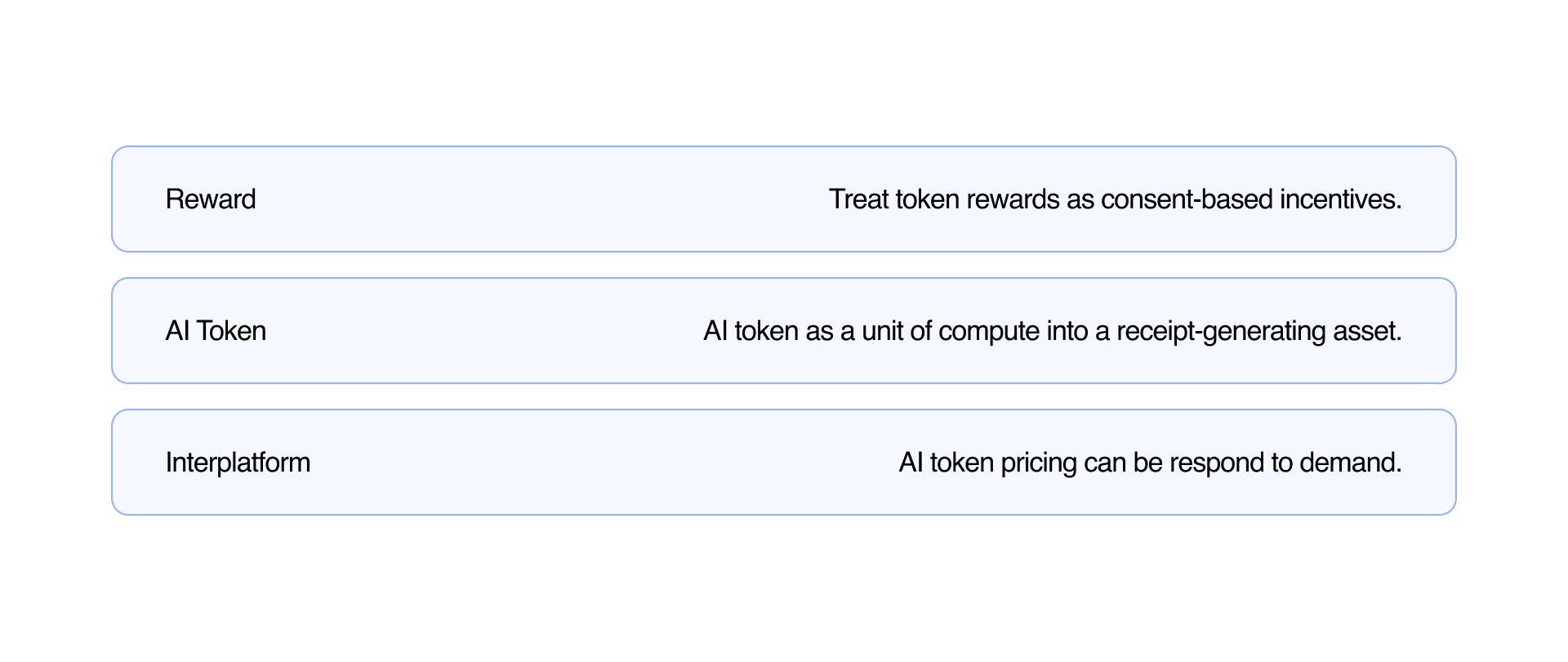
AI token rewards — as consent-based incentives for data contribution — transform data into a transactional asset circulating within a self-sustaining loop, enabling systematic audit and traceability throughout.

AI Token

The AI token moves beyond its role as a unit of computing into a receipt-generating exchangeable asset — functioning as a currency tied to quantifiable indicators for data exchange.

Interplatform

Consolidating siloed AI token units across platforms into a unified framework enables demand-driven pricing, greater service utility for users, and automation across a broader range of services.

Value shift across
the ecosystem

The primary barrier to data compensation has not been technical, but definitional. Without a consistent framework for measuring data value, fair exchange has been structurally impossible. DQI establishes that measurement layer — effectively serving as the exchange rate system of the data economy.

USER PERSPECTIVE
Dimension As-Is To-Be
Visibility No visibility into how data is used Visible, actionable data ownership
Compensation Data extracted with zero compensation AI token rewards based on DQI
Agency Vague anxiety and uncertainty Direct control over data sharing scope
AI ENTERPRISE PERSPECTIVE
Dimension As-Is To-Be
Risk Unauthorized collection → litigation & regulatory risk Consent-based collection → liability protection
Data Quality Inconsistent data quality High-quality data selection powered by DQI
Reach Limited scope of data collection Expanded reach through trusted framework

When data is contributed willingly, liability converts to protection, quality becomes a selectable standard powered by DQI, and collection expands on the basis of trust rather than resistance.

Strategic partnerships
across three layers

For commercialization at scale, the strategic foundation spans infrastructure partners, government bodies, and regulated AI enterprises — each playing a distinct role in the governance ecosystem.

INFRASTRUCTURE PARTNERSHIP
Safe Superintelligence Inc.
Technical Advisor
Okta
AI Identity and Access Management
GPAI
Global Partnership on Artificial Intelligence

SSI as technical advisor, Okta as authentication and identity management infrastructure, and GPAI to support global market entry.

B2G — GOVERNMENT PARTNERSHIP
Government of Canada
Primary Regulatory Body
Office of the Privacy Commissioner
Compliance & Oversight (OPC)

Government bodies are informed of program outcomes and consulted for input, retaining authority to exert regulatory influence over compliance boundaries, information exchange, and AI token transactions.

B2B — REGULATED AI ENTERPRISES
Gemini · Claude · ChatGPT
Subjects of Regulation

AI enterprises gain the ability to convert and manage tokens across multiple streams within a unified platform, while unlocking structured information exchange and access to high-quality, consent-sourced data.

Three-layer governance
ecosystem

Each participant is positioned across three concentric rings — governing bodies at the core enforcing the framework, regulated AI enterprises in the middle, and affected parties at the periphery.

Layer I — Governing Bodies Layer II — Regulated Entities Layer III — Affected Parties

Three components,
one system

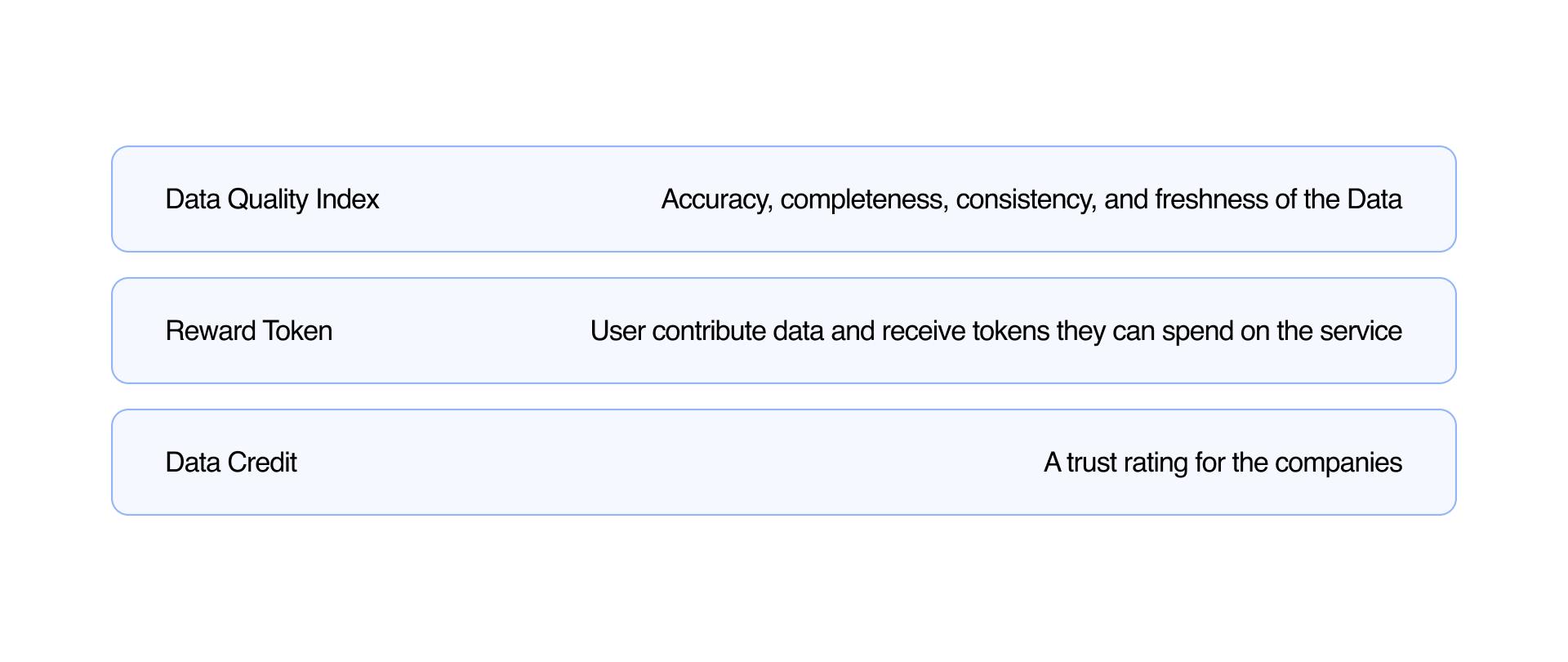
DQI measures data worthiness, Reward Tokens translate that into direct compensation, and Data Credit converts accumulated value into purchasing power — forming a closed-loop governance system.

COMPONENT I
DQI
Data Quality Index — "The worthiness of data"
.I
Accuracy

Data must accurately reflect the real world at all times. Errors directly trigger regulatory penalties with serious consequences.

.II
Completeness

All required fields and records must be fully completed. Gaps in audit trails constitute direct compliance violations.

.III
Consistency

The same data point holds the same value across all systems. Discrepancies between sources are inadmissible under regulatory review.

.IV
Freshness

How current and up-to-date the data is, and whether the latest elements and updates have been properly applied and reflected.

Gate
Privacy Sensitivity

Operates as an independent gate. If triggered, DQI output is fully blocked until encryption, anonymization, and mandatory user notification protocols are resolved.

COMPONENT II
Reward Token
"Value returned to users"
User
Data → Token

Users provide data and receive token refunds, which can be utilized for service use and applied as a new form of value across the platform.

Enterprise
Token → Quality Data

AI enterprises validate the quality of information and enable high-quality data to be trained into future models — completing the exchange loop.

Loop
AI Token Ecosystem

A data circulation structure that benefits both the company and its users — fundamentally grounded in consent and exchange, forming a new economic system built on mutual benefit.

COMPONENT III
Data Credit
"Compliance trust rating"
.I
Corporate Credibility

Functions as a benchmark for measuring corporate data utilization credibility — much like a technical benchmark, directly tied to data sovereignty.

.II
Audit Transparency

Extent to which user consent boundaries were respected, verified through internal and external audit-based validation procedures.

.III
Reward Fulfillment Rate

Whether promised tokens for data collection were actually distributed, and how effectively distributed tokens can be utilized within the service.

.IV
DQI Accuracy

Whether data value was assessed fairly, with objective metrics ensuring all factors in the valuation process were applied equitably.

.V
Consent Compliance Rate

Whether the company transparently disclosed how user data was utilized and whether users were properly informed of how data is processed and retained.

How the service
connects

The three service components bridge AI enterprises and users — with regulatory oversight and audit mechanisms embedded directly within enterprise infrastructure rather than imposed externally.

User / Data Agencies

Provides data · Receives reward tokens · Third parties

tokentrust
Data Quality Assessment Reward Engine Data Protection Ensure Copyrights Intuitive UI
AI Enterprises

Data-AI Token exchange · Interplatform unified exchange

Regulatory Body

Enforce the program · Data usage audit · [Report] ↔ [Enforce]

Stakeholder Layers

Layer I — Governing Bodies: Government of Canada, EU AI Act, OECD AI Principles, ISO/IEC 42001, NIST AI Framework
Layer II — Regulated Entities: OpenAI / GPT, Google DeepMind / Gemini, Anthropic / Claude, Amazon / Nova, Meta AI / Llama
Layer III — Affected Parties: Content Creators, Healthcare Providers, Financial Institutions, Academic Researchers, Enterprise Data Teams

Four blue-ocean
market positions

Competitors operate on a "use → deplete" model. TokenTrust enables a "use → refund → recirculate" loop — occupying the highest position on both user value return and interplatform fungibility across four distinct markets.

AI Token Market · TAM$30B+
AI Token Market
Gap
Existing AI tokens focus solely on utility within their own ecosystems. Inter-platform token refund and conversion remains a complete blue ocean.
Positioning
Highest position on both token fungibility (x) and user value return (y). The only platform with a "refund" mechanism.
Advantage
Competitors operate on "use → deplete." This platform enables "use → refund → recirculate."
Cross-platform Interoperability · TAM$15B+
Cross-platform Interoperability
Gap
Existing integration platforms focus exclusively on "data movement." The space for "value (token) movement" remains entirely unoccupied.
Positioning
Dominant advantage on token and value portability. The only player combining AI-native integration with token conversion.
Advantage
Positioned at the inflection point where iPaaS evolves from "data pipes" to "value pipes."
Data-as-a-Service · TAM$12B+
Data-as-a-Service
Gap
Existing DaaS platforms operate on a "companies buy and sell data" model. A user value return model is entirely absent.
Positioning
Highest position on data sovereignty (x) and value redistribution (y). Consent-based compensation is the core differentiator.
Advantage
Aligned with the surge in data sovereignty demands driven by EU AI Act and GDPR enforcement.
AI Regulatory Compliance · TAM$5B+
AI Regulatory Compliance
Gap
Every competitor approaches compliance from a "penalty avoidance" perspective. The "compliance = user reward" framing is a unique position.
Positioning
Proprietary benchmarks — consent compliance rate, reward fulfillment rate, valuation fairness — serve directly as regulatory evidence.
Advantage
Resolves data sovereignty and regulatory compliance simultaneously through a corporate credibility index.

Three-horizon
market entry

Prior to market entry, the strategic priority is establishing foundational market trust and a stable infrastructure capable of sustaining long-term operations — scaling from controlled pilot to institutional adoption.

H-I
Immediate Milestones
Market Entry · Y0–Y1
Building the core governance infrastructure of the system
Data Quality Index (DQI) implementation and consent logging mechanism
Audit-ready records of data collection — no open token circulation
Rewards limited to internal credits and controlled pilot incentives
H-II
Growth Targets
Market Entry · Y1–Y3
Pilot partnerships with selected AI enterprises
Adapting DQI model to sector-specific needs
Validating consent and reporting workflows
Internal audit of whether user reward structures can operate measurably and reliably
H-III
Long-term Vision
Market Entry · Y3+
Scaling the system through standardization and institutional adoption
Expanding audit partnerships and introducing certification and reporting structures
Building a broader governance framework across jurisdictions
A trusted infrastructure for data quality, accountability, and compensation

Beyond simple
redemption

This positions AI token commerce not merely as an exchange mechanism, but as the infrastructure that enables fluid movement of value across platforms and participants.

"Beyond simple redemption or transactional utility, TokenTrust carries an inter-platform character that guarantees user autonomy and expands service accessibility for AI enterprises."

AI Data Governance Society · GDES-3081-501 · Group 14 · March 23, 2026

← Back to Part I
PHASE II · APRIL 2026
From Data Ownership
to Data Economy

A Regulatory and Operational Blueprint for TokenTrust — Canada-specific compliance infrastructure, four value axes, and a RACI-governed accountability structure.

Phase II

Who owns the value
created from our data?

Phase I established TokenTrust as a global framework. Phase II defines a concrete pathway to operationalize it within Canada's regulatory environment — turning concept into blueprint.

PHASE I ESTABLISHED
Global regulatory landscape & token economics

TokenTrust was proposed as a solution within the global AI data governance framework — positioning the DQI, Reward Token, and Data Credit as the core service components of a new data economy.

PHASE II DELIVERS
Canada-specific operational blueprint

We now know data has value. But the systems that capture that value were never designed to return it. Phase II maps the compliance infrastructure, accountability structure, and regulatory partnerships required to make TokenTrust operational.

Existing interplatform services — OpenRouter, Perplexity, Cursor, Copilot — already enable AI service aggregation. But you have no control over your data. TokenTrust is not about service accessibility. It is about value flow.

Four axes,
one operational system

Each value axis activates at a different horizon. Traceability is the earliest prerequisite. Regulatory spans all phases. Refund begins at pilot stage. Interplatform opens only after cross-border governance is secured.

AXIS I
Data Traceability

DQI assigns measurable identity to data through four dimensions. Without traceability, no refund, no compensation, no accountability.

AXIS II
Data Refund & Compensation

A circular model replaces one-way consumption. Use → Refund → Recirculate. Refund does not exist anywhere in the current AI token market.

AXIS III
Interplatform Value Management

Like VISA unified payments across banks, TokenTrust unifies token value across AI platforms. From data pipes to value pipes.

AXIS IV
Holistic Regulatory Alternative

Regulation is not a cost of compliance — it is a prerequisite for value creation. Without regulatory foundation, the other three axes have no legal weight.

Data Traceability:
DQI as infrastructure

In today's AI ecosystem, user data becomes untraceable the moment it is submitted. DQI is not a quality metric — it is a tracking infrastructure.

CURRENT STATE
Data submitted → immediately untraceable

Once data enters an AI platform, users lose all visibility into its path, usage, or worth. There is no mechanism to identify, track, or compensate for its contribution to model training or service generation.

TOKENTRUST AXIS I
DQI assigns measurable identity to every data point

Through Accuracy, Completeness, Consistency, and Freshness, DQI creates a traceable fingerprint for each data contribution. Measurable data carries traceable value. Traceable value is compensable value.

Data Refund:
Closing the loop

Existing AI token economies operate on a one-way consumption model. TokenTrust introduces a circular model — making refund structural, not optional.

EXISTING MODEL
Use → Deplete

Tokens are spent, value is depleted, and the user retains nothing. The platform benefits from data contribution while the user receives no return. Refund does not exist anywhere in the current AI token market.

TOKENTRUST MODEL
Use → Refund → Recirculate

Data contribution is evaluated through DQI, compensated via Reward Token, converted into Data Credit, and reinvested into service access. TokenTrust makes refund structural — the first AI platform to do so.

Interplatform value:
From pipes to worth

Existing platforms aggregate services. TokenTrust consolidates value. Your data doesn't lose worth when it moves.

EXISTING INTERPLATFORMS
Aggregate services — data pipes

OpenRouter, Copilot, and similar tools move data between AI providers. They unify access, not value. Token worth is siloed, non-portable, and non-compensable across platform boundaries.

TOKENTRUST AXIS III
Consolidate value — value pipes

Like VISA unified payment rails across banks, TokenTrust functions as the value consolidation layer — a unified exchange infrastructure where tokens carry measurable worth across platforms, are priced by demand, and remain portable.

Regulation as
the foundation layer

Regulation activates the other three axes. Without regulatory foundation, traceability has no legal weight, refund has no enforceable structure, and interplatform exchange has no jurisdictional legitimacy.

EVERY COMPETITOR'S APPROACH
Risk & Penalty avoidance

Every competitor in the AI regulatory compliance market operates from a penalty avoidance perspective — treating compliance as a cost to manage and minimize, not as infrastructure to build upon.

TOKENTRUST AXIS IV
Compliance = user reward + service foundation

PIPEDA, FINTRAC, CBPR, and ISO/IEC 42001 are not obligations to manage — they are infrastructure to build on. TokenTrust reframes compliance as user reward: the same framework that satisfies regulators generates trust, enabling DQI to carry legal weight.

Token economy model:
Axis dependencies

Each value axis contains eight operational factors. The connections represent structural dependencies — Traceability enables Refund, Regulatory governs all axes, and Interplatform requires all three to be operational before activation.

AXIS IV — GOVERNS ALL
Holistic Regulation

The regulatory layer is not sequential — it governs the entire stack from day one. PIPEDA consent logic underpins DQI. FINTRAC classification determines token exchange legality. Without this layer, no other axis has legal standing.

PIPEDA FINTRAC ISO/IEC 42001 Global CBPR
AXIS I — PREREQUISITE
Data Traceability

The first axis to activate. DQI establishes the measurement layer — without it, Refund cannot be calculated, Interplatform cannot be priced, and Regulatory has nothing to audit.

AXIS II — ENABLED BY AXIS I
Data Refund & Compensation

Activated once Traceability is live. DQI scores feed directly into the Reward Token calculation engine — closing the loop between data contribution and economic return.

AXIS III — REQUIRES ALL THREE
Interplatform Value Management

Opens only when Traceability, Refund, and Regulation are all operational. Cross-border token portability requires data to be measurable (Axis I), compensable (Axis II), and legally exchangeable across jurisdictions (Axis IV). The shift from data pipes to value pipes is the final activation.

Three regulatory
horizons

Each horizon is defined by a guiding compliance question. The answer to each unlocks the next layer of the platform's operational capacity.

H-I
"Can we legally operate?"
Present · Y0–Y1
Establish PIPEDA compliance framework & consent logging (Schedule 1, Principle 4.3)
Designate CIPP/C-certified Data Protection Officer (Principle 4.1)
Register with FINTRAC as a Money Services Business (PCMLTFA, s. 5(h))
Internal execution only — single-entity consultation with CTO and Okta
H-II
"Who governs our governance?"
Y1–Y3
Apply for OPC regulatory sandbox for token-based data exchange
Activate PACC network for government channel access
Build advisory relationship with Office of the Privacy Commissioner
GPAI consulted for global regulatory precedent — ISED informed
H-III
"Can our data cross borders?"
Y3+
Achieve ISO/IEC 42001 AI Management System certification
Pursue Global CBPR certification for cross-border data transfer legitimacy
SSI Inc. and GPAI jointly advise on technical and policy standards
AI Enterprises enter the Informed layer as direct participants

What must be in place
before TokenTrust can operate?

Five regulatory instruments form the compliance foundation. Together they define TokenTrust's legal scope, reporting obligations, and cross-border legitimacy.

PRIMARY · H-I
PIPEDA
Personal Information Protection and Electronic Documents Act

Applies at every layer: collection, valuation, compensation, and cross-platform transfer. TokenTrust's compliance scope extends far beyond standard consent obligations — the DQI-to-token pipeline directly determines what constitutes "data collection" under federal law.

REQUIRED · H-I
FINTRAC MSB
Financial Transactions and Reports Analysis Centre of Canada

Token exchangeability triggers MSB classification under FINTRAC. Registration is a precondition, not an option. Okta's authentication infrastructure defines the scope of reportable transactions — making it a consulted party in this process.

REQUIRED · H-I
CIPP/C
Certified Information Privacy Professional / Canada

Embedding a CIPP/C-certified professional within the compliance team ensures PIPEDA-aligned data governance from the operational level — not just as a legal formality but as a structural accountability mechanism.

ADVISORY · H-II
OPC & PACC
Office of the Privacy Commissioner + Privacy & Access Council of Canada

OPC provides advisory guidance on PIPEDA compliance for TokenTrust's data-token exchange model. Annual transparency reports submitted to OPC. PACC serves as a professional network for building credibility within Canada's privacy governance community.

GLOBAL · H-III
Global CBPR
Cross-Border Privacy Rules Forum

As TokenTrust's token ecosystem operates across AI enterprises in different jurisdictions, cross-border data transfer is a structural requirement. CBPR provides the legal framework for international data flow — unlocking Axis III's full interplatform capability.

CERTIFICATION · H-III
ISO/IEC 42001
AI Management System International Standard

Certifies TokenTrust's AI governance standards at the global level. ISO/IEC 42001 certification establishes the international governance standard as TokenTrust scales globally — providing the regulatory credibility required for enterprise-level partnerships.

Four-layer governance
accountability

TokenTrust's governance operates across four layers — each with a distinct accountability scope and relationship to the platform's operational compliance structure.

I
Internal
CEO/Founder · Legal & Compliance (CIPP/C) · CTO · DPO

Holds accountability for regulatory compliance execution and platform governance operations. The primary decision-making and execution layer.

II
Regulators
OPC · FINTRAC · ISED

Sets the legal boundaries within which TokenTrust must operate and report. Consulted or informed at each horizon depending on the regulatory instrument.

III
Partners
Okta · SSI Inc. · GPAI

Okta and SSI Inc. supply authentication and identity verification infrastructure. GPAI operates as an international policy advisory body for AI governance alignment across jurisdictions.

IV
AI Enterprises
Gemini · Claude · ChatGPT · Grok · others

Operate as primary institutional participants within TokenTrust's data governance and token compensation framework. Enter the Informed layer at H-III as direct ecosystem participants.

Internal team
bridges both

Hover or tap a category to trace its relationships. The Internal team is the bridge — their roles in the stakeholder map map directly to accountability in the RACI structure.

Stakeholder Map
RACI Radial

Internal accountability
across three horizons

Internally, TokenTrust automates RACI-based reporting and assessment to streamline regulatory audits and data tracking. The matrix expands as the platform matures — from internal-only to full multi-entity consultation.

Stakeholder H-I · Present H-II · Y1–Y3 H-III · Y3+
Internal
CEO / Founder A A A
Legal & Compliance (CIPP/C) R R R
CTO C C C
DPO (Data Protection Officer) R A A
Regulators
OPC (Privacy Commissioner) C C
FINTRAC I I
ISED I I
Partners
Okta / SSI Inc. C C C
GPAI C C
AI Enterprises
AI Enterprises (Gemini, Claude, GPT…) I
R Responsible — executes the task A Accountable — owns the outcome C Consulted — provides input I Informed — kept up to date

Navigating the
token economy

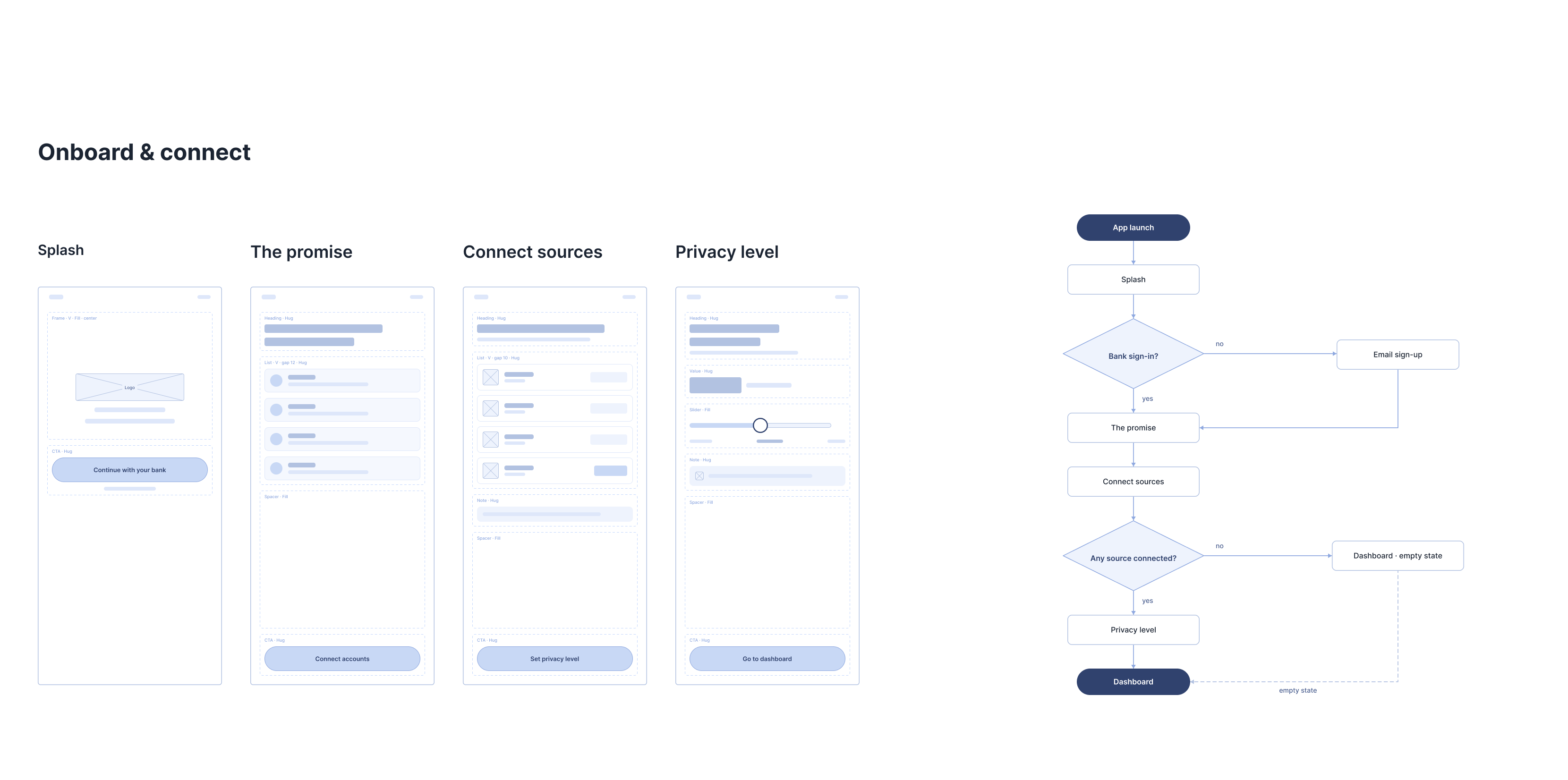
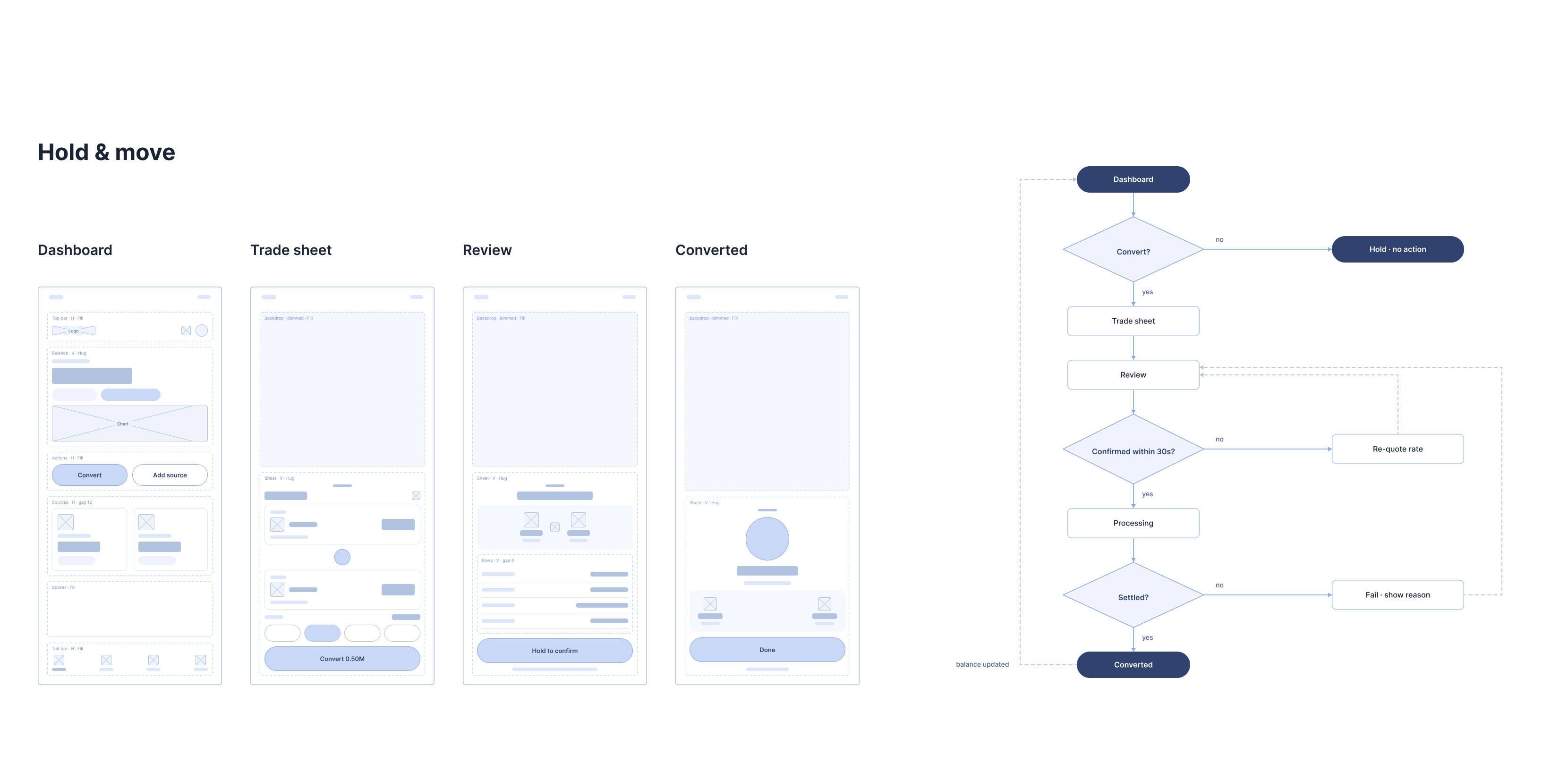
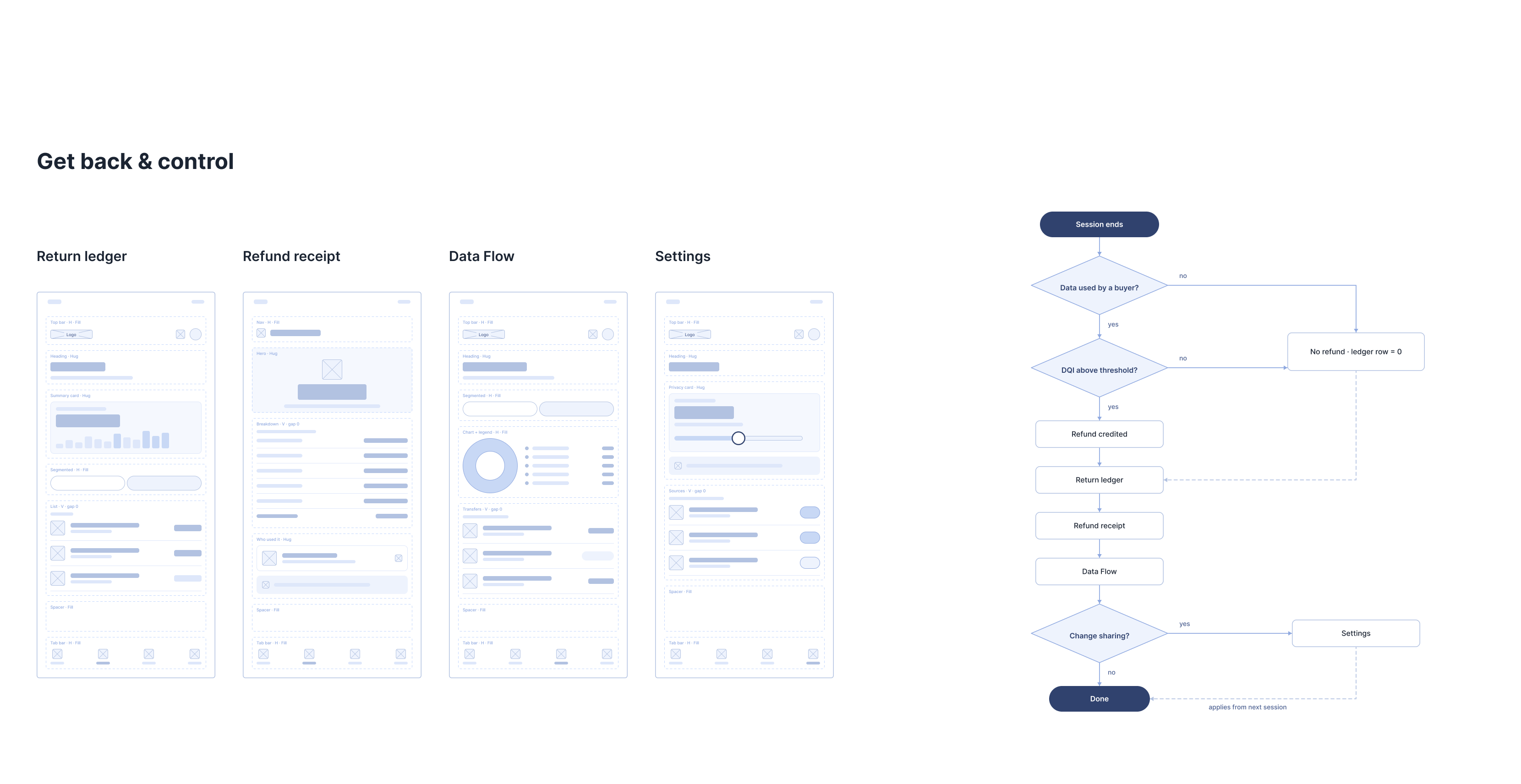
Each layer answers a distinct navigational question. Together they form a complete wayfinding system — enabling users to orient, trace, retrieve, and control within the token economy.

WHERE AM I
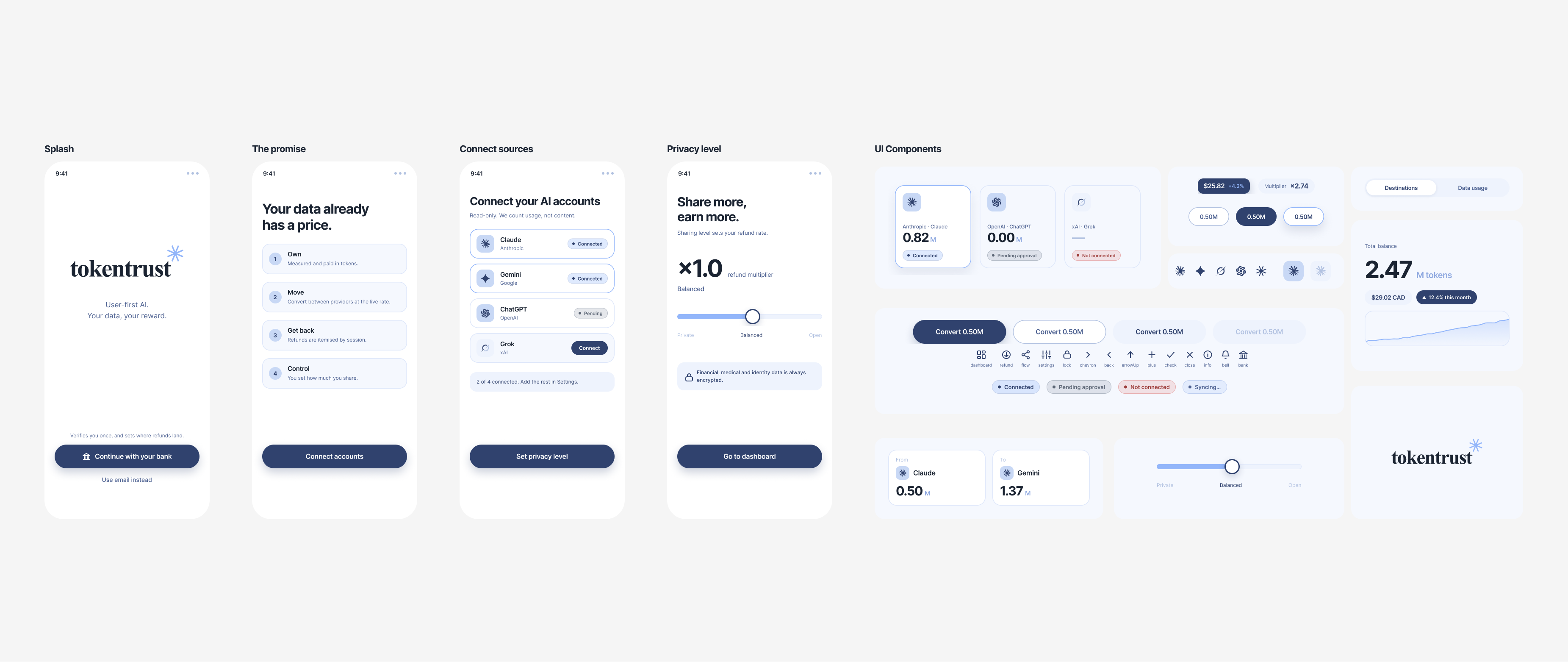
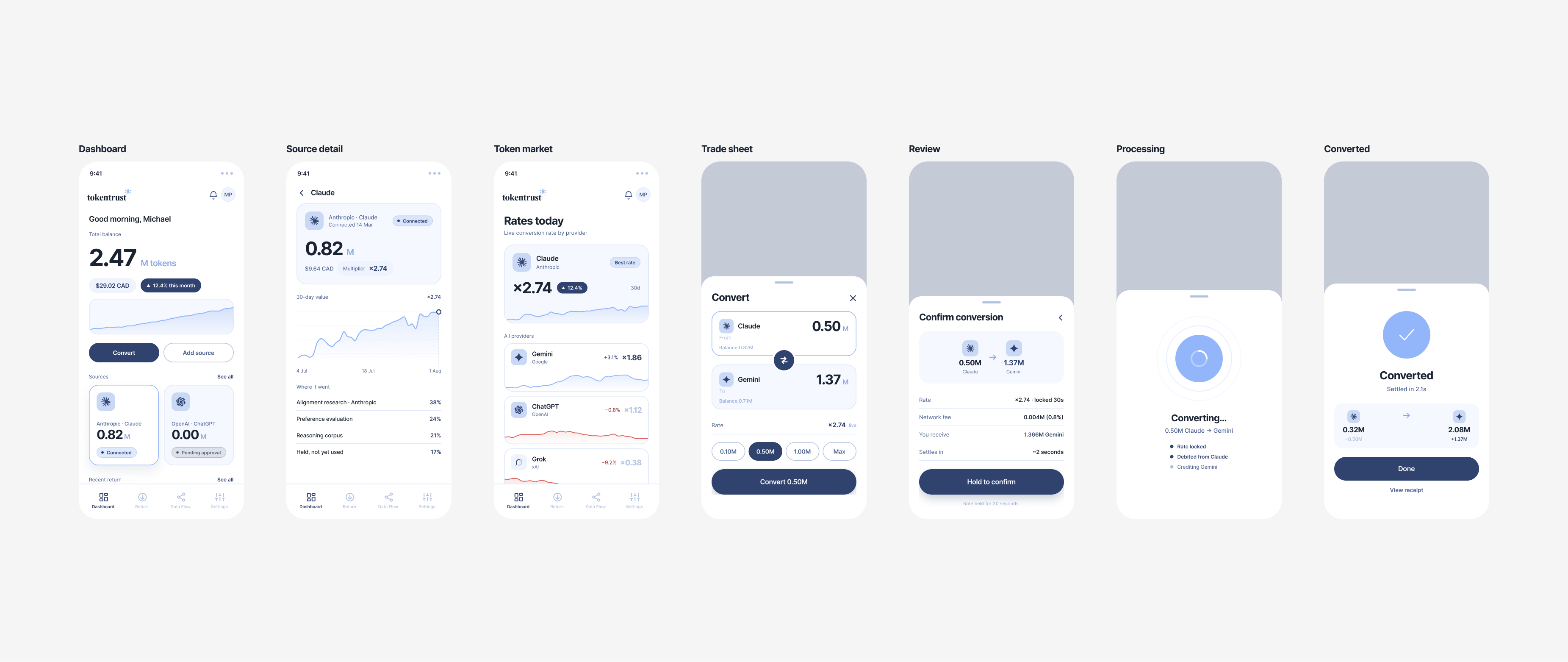
Dashboard

Token balance, value status, portfolio overview. The entry point — giving users an immediate read of their position within the token ecosystem.

WHERE DID IT GO
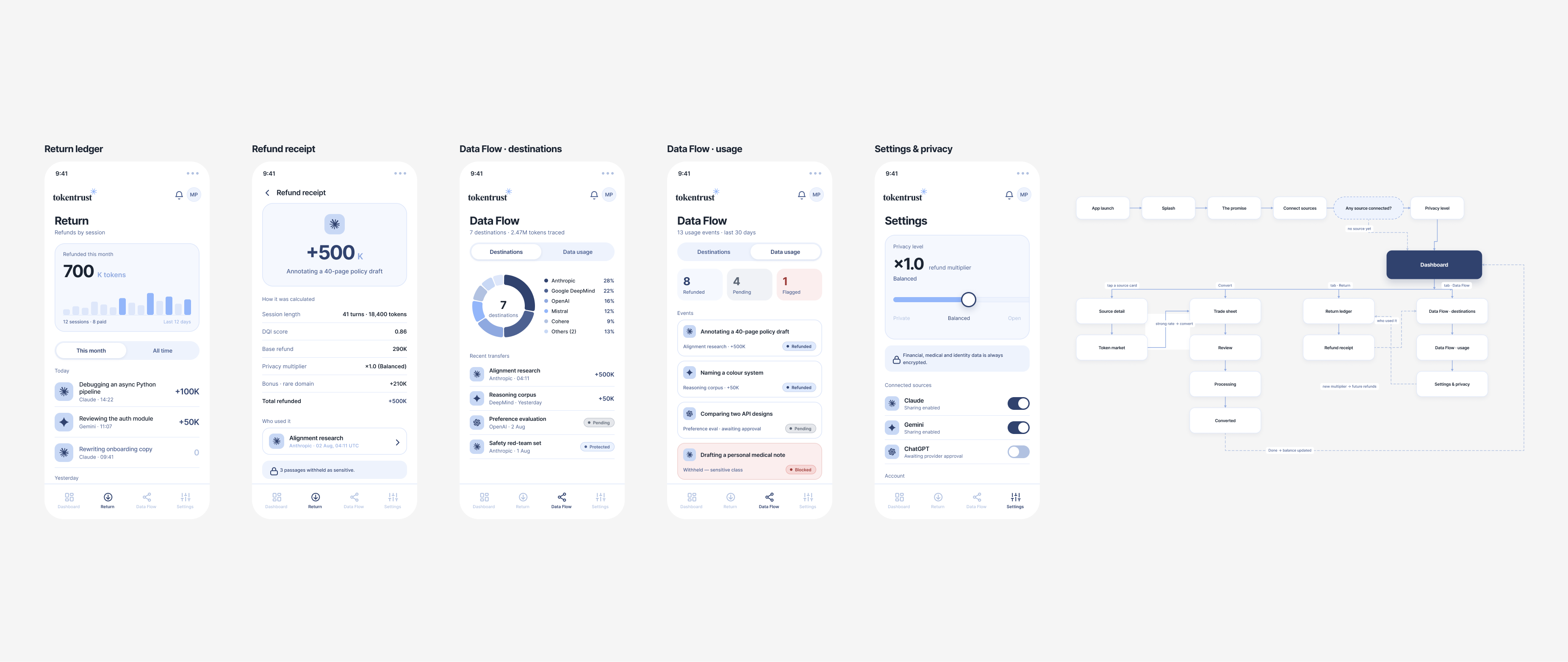
Data Flow

Destination tracking, usage path, transfer history. Allows users to trace exactly how and where their data contribution moved through the system.

WHAT CAME BACK
Return

Refund history, compensation records, earned value. The full record of what the system has returned to the user in exchange for their data contribution.

HOW DO I CONTROL IT
Settings

Privacy level control, consent boundary configuration, reward rate adjustment. The governance layer — placing data sovereignty directly in the user's hands.

Service Component
Detail Overview

TokenTrust operates across three distinct service models — each designed to match a different usage profile and cost expectation. From feature-scoped high-volume access to fully cross-platform deployment, the architecture allows users to engage with AI on their own terms while remaining within a unified token governance system.

FFM
Feature-Focused Model

Access to a defined set of core AI capabilities — features are intentionally scoped rather than open-ended. In exchange, usage volume scales dramatically: users can run significantly more interactions, queries, or outputs within the same cost envelope. Designed for high-frequency, focused workflows where breadth matters less than throughput.

FM
Flexible Model

Priced above conventional flat-rate plans, this model introduces variable total cost tied directly to actual usage. The more you use, the more you pay — but only for what you consume. Suited for users whose workloads fluctuate, offering full feature access without the overhead of a fixed ceiling that may go unused.

IAM
Interplatform Activation Model

Extends AI access across third-party environments — deploy capabilities inside tools like VS Code, Cursor, or Manus AI without leaving the platform. Usage across all connected surfaces is unified and regulated through TokenTrust's token exchange system, giving users a single point of control over consumption, cost, and data flow regardless of where they work.

From blueprint
to operation

Phase II defined the regulatory foundation and accountability structure required to make TokenTrust operational — from Canadian compliance to global governance readiness.

"This positions AI token commerce not merely as an exchange mechanism, but as infrastructure that requires compliance as its base layer before value can flow."

Next: Pilot operations and market validation on this regulatory infrastructure · AI Data Governance Society · April 5, 2026